Recorded events
Largest magnitude
Median depth
Events M ≥ 4.0

Independent analysis and visualization of public earthquake bulletins.
Magnitude trend (1 day)
Magnitude trend (30 days)
Map © Esri and contributors. Surface imagery at sea level. Volcano cones are illustrative symbols, not actual elevations or alert levels.
| # | Magnitude (M) | Location | Depth (km) | Time (PHT) |
|---|
Loading weekly overview...
ANALYSIS
18 Oct 2026 - 24 Oct 2026
Weekly seismic activity & tectonic setting
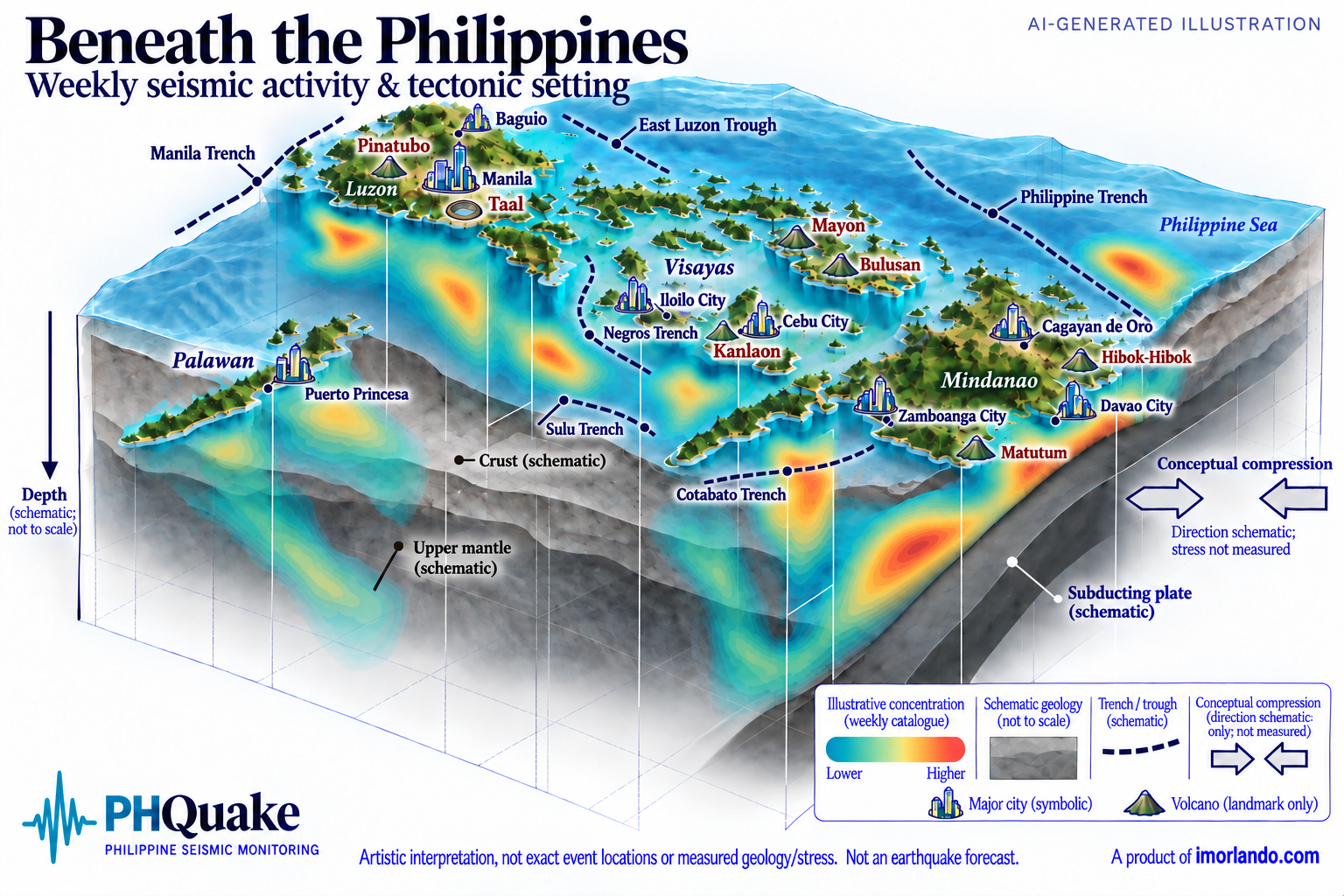
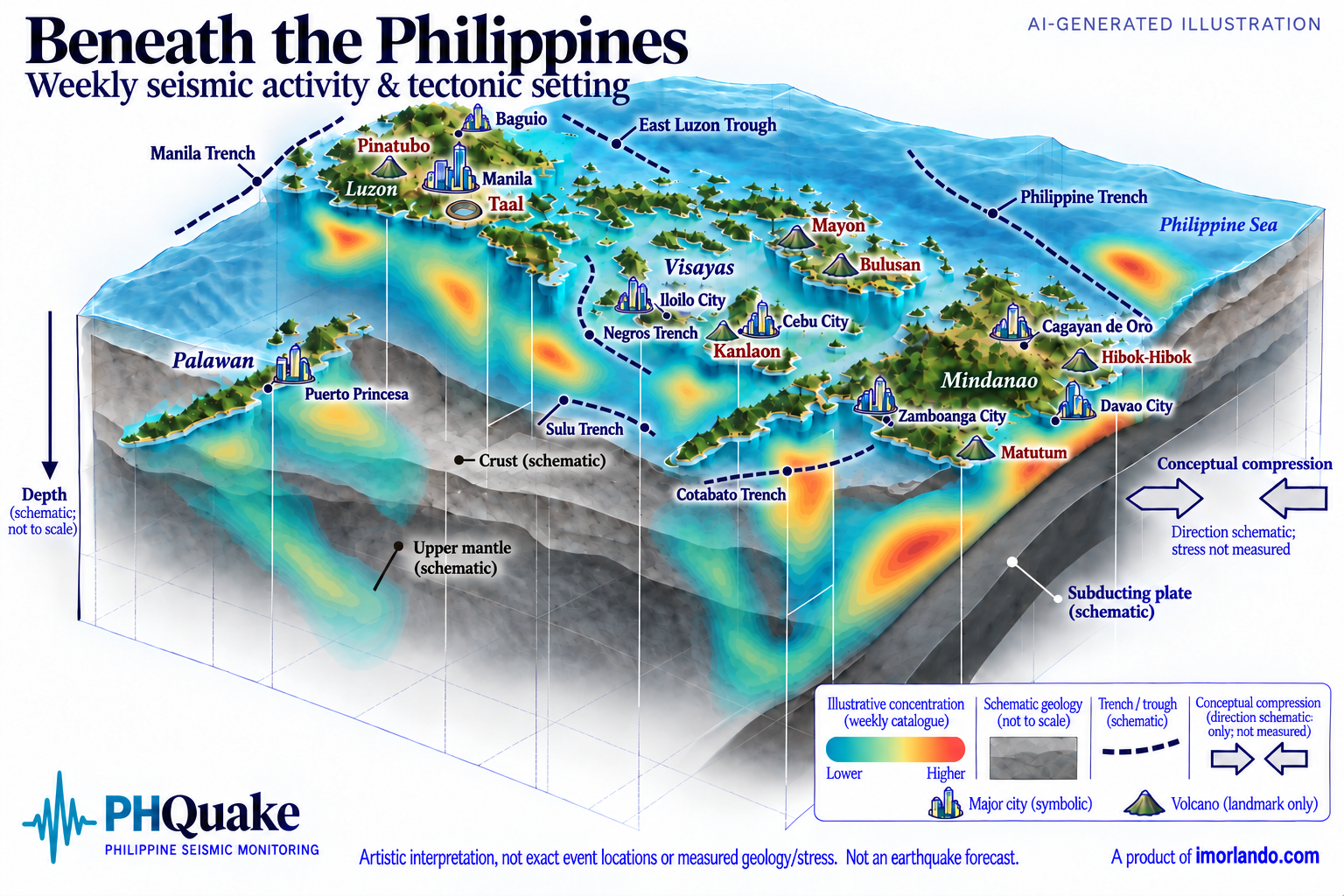
Imagine looking down at the Philippines and seeing most of a week’s earthquake dots gather around Mindanao, while a few lie far below the surface. From 00:00 on 18 October to 20:00 on 24 October 2026, the catalogue recorded 370 events, with the largest regional count in Mindanao: 193. Most were shallow, but the depths ranged widely. These are all recorded events in the stated window, not a sample; the final day is incomplete.
Magnitude describes an earthquake’s size, while depth tells us where it began below the surface. Neither, by itself, says how strongly shaking was felt at a particular place. The median magnitude was 2.1: the midpoint, with half the recorded values at or below it and half at or above. In all, 323 events were below magnitude 3, while one reached magnitude 5. That largest example was reported as “073 km N 23° E of Mapanas (Northern Samar)” at a depth of 10 km. It is an extreme in this week’s catalogue, not a description of a typical event.
Depth shows a different contrast. The median was 27 km, and 335 events originated shallower than 70 km. Thirty-four were between 70 and 300 km, and one was deeper than 300 km; the full range was 1 to 598 km. The deepest event is therefore far from typical. USGS explains that intermediate and deep earthquakes are generally associated with deformation within a subducting slab: a relatively cold oceanic plate carried down into the mantle. But depth alone cannot identify a particular trench or reveal the shape of a slab beneath the Philippines.
A second way to look at the week is to ask where events gathered in space. A DBSCAN analysis grouped nearby hypocentres—estimated underground origins—using a 45 km neighbourhood scale and requiring at least 12 samples to form a group. Its largest concentration contained 101 events, centred near 5.502° N, 125.305° E, around the southern Mindanao region. Its depths ranged from 1 to 39 km, with a median of 29 km. A smaller group of 18 lay near 9.58° N, 126.153° E, with depths from 9 to 35 km. The 45 km scale is not a maximum cluster size: density-connected groups can extend farther. Nor does spatial grouping establish a shared fault or a time-linked sequence, so these are not, on that basis, “aftershocks” or “swarms.”
The larger group is geographically near mapped candidate faults, including the Daguma Extension Mindanao Fault. Within that cluster, five shallow events fell within the stated screening distance of this candidate trace. Across the whole catalogue, the screening considered 233 events at depths of 30 km or less; 75 were within 25 km of a mapped trace. These are proximity results, not evidence that a named fault caused or ruptured in any event. A surface trace and its mapped slip type do not reveal an earthquake’s source at depth or its focal mechanism—the direction and style of movement during rupture. The reference traces come from GEM’s regional-scale database, whose inventory may omit faults, especially offshore ones.
PHIVOLCS describes strike-slip faults as moving blocks mainly sideways, and reverse faults as involving compression and upward movement of one block relative to another. These are useful ways to picture mapped fault styles, not measurements of this week’s earthquakes. Shallow events can be compatible with crustal faulting, but the catalogue does not establish which structure, if any, was involved. A nearby trace is a little like a road on a map: it helps orient us, but does not show which route a traveller took underground.
For context, the latest complete week, 17–23 October, recorded 393 events, the same as the previous complete week, 10–16 October. Its average of 56.14 per day was 20.3% below the preceding 90-day average of 70.48, for 19 July–16 October. These are descriptive catalogue comparisons, not evidence of changed stress or hazard. The current report includes 24 October only up to 20:00, so its 39 events must not be compared with full days as a sign of declining activity. Daily counts measure catalogue entries, not future risk; no felt-intensity observations are supplied. Catalogue completeness is unverified, and zero-record days would not prove seismic quiet.
A simple historical-volume baseline gives 67.88 catalogue events for a 24-hour period, based on the 90 days from 26 July to 23 October. This is not a trained earthquake prediction. In a chronological backtest over 24 September–23 October, the 90-day baseline’s mean absolute error was 13.59 events per day across 30 evaluated days. The 30-day baseline did better, with an error of 11.64; the 180-day baseline did worse, at 21.6. More history does not automatically improve count estimates, and one evaluation period cannot establish a universally better method. These errors are not prediction intervals.
The evidence supports a picture of mostly small, shallow recorded events, alongside a few much deeper ones and two spatial concentrations. It does not establish a source fault, a change in danger, or what will happen next. Better attribution would require focal mechanisms, more precise event locations and their uncertainties, and fault geometry; a fitted slab model would help assess deeper events. Until then, mapped proximity and depth are clues for investigation, not a verdict.
Computed live from the most recent 30 days of events.
Slip estimates assume a 120 × 70 km fault and shear modulus of 30 GPa.
Loading 3D view...
No event selected
Recorded hypocentres · Indicative trench traces · Section distance: great-circle km · 3D vertical scale: 1x
Surface imagery © Esri, Maxar, Earthstar Geographics and contributors. Imagery is draped at sea level, not an elevation model. Volcano references are not live alert levels.
The analysis of fracture clusters beneath the Philippines reveals critical insights into the region's tectonic dynamics and associated seismic hazards. Our examination here, based on event clusters, centroids, and depth ranges, identifies key characteristics of nine clusters across the area, each with distinct implications for seismic activity and hazard evaluation.
Cluster Overview:
Centroid located at 157.7 km along-strike and -40.6 km across-strike. This cluster is the most active, indicating a significant concentration of seismicity. Geographically, it aligns closely with the Manila Trench, suggesting it may be influenced by subduction processes.
Positioned at approximately 392.7 km along-strike, this cluster is situated in the eastern region near the Philippine Trench. The deeper average depth (26.3 km) suggests a relationship with the trench's activity and potential for larger subduction zone earthquakes.
Cluster 3, at -171.4 km along-strike (near the Mindanao region), shows a range of depths (2.0–101.0 km) indicating more complex tectonic interactions. In contrast, Cluster 4, located at -193.9 km, has a similar depth range (1.0–59.0 km) but lacks significant seismicity, perhaps indicating a less active tectonic environment.
These are less active, with clusters occurring at spatially more distant positions from major trenches. Clusters 5 (-107.2 km) and 6 (-191.9 km) have depths of about 6.0–30.0 km and 7.0–37.0 km, respectively, yet they may represent evolving stress fields rather than stable fault lines.
Clusters 7 (273.1 km) and 9 (-279.5 km) demonstrate mild seismicity, with narrower depth ranges, possibly indicating minor tectonic adjustments. For instance, Cluster 9’s location in a complex region suggests intricate interactions between nearby geological formations. Cluster 8 is very localized and characterized by shallow depths (1.0–33.0 km), indicating potentially minor, shallow crustal faults.
With shallow depths, Cluster 11 (266.4 km) shows less seismic activity and could suggest a stable area or insufficient data coverage.
Tectonic Implications:
The presence of these clusters indicates that the Philippines is situated at a critical convergent boundary with the Eurasian Plate and the Philippine Sea Plate. The more active clusters (1 and 2) align with significant geological features that drive earthquake generation, while the less active clusters can indicate areas of stress accumulation or tectonic quiescence.
Hazard Implications:
The primary risk from the identified clusters, particularly from Clusters 1 and 2, is the likelihood of significant seismic events affecting densely populated regions. As such, a better understanding of these clusters can aid in informing earthquake preparedness and risk mitigation strategies.
In conclusion, the analysis provided here illustrates not only the seismicity of the Philippines but the importance of monitoring these clusters to improve hazard assessments and readiness. This understanding can facilitate better urban planning and disaster response strategies in an earthquake-prone region.
This analysis was generated by the AI model GPT-4.
Observed spatial concentrations · PHIVOLCS catalogue
Analysis not loaded.
| Cluster | Events | Centre (lat, lon) | Mean depth | Depth range | Max M | Latest event (PHT) |
|---|
Spatial groups, not confirmed faults or earthquake predictions. Density surfaces estimate concentrations of recorded events; percentages are relative density, not earthquake probabilities. Smoothing is clipped at the surface. Time limits the catalogue; it is not a clustering dimension. Cluster IDs apply only to this analysis.
7-day and 30-day comparisons · separate 90-day historical baseline
Activity-based outlook, not an earthquake prediction or an official hazard forecast. Falling counts do not imply lower earthquake risk.
Loading historical SQL catalogue...
1° cells, approximately 100 × 111 km; not administrative boundaries.
| Area / cell centre | 7 days | Prior 7d | Change | Trend | 90d baseline / day |
|---|
| History | Cell MAE / day | National MAE / day | National RMSE / day | National bias / day | Evaluated days |
|---|
MAE is mean absolute count error; RMSE gives larger errors more weight. Bias is predicted minus observed count. Lower MAE is better in this retrospective sample, not proof of future reliability. The 90-day baseline remains a reference, not an automatically validated forecast.
Source: PHIVOLCS event catalogue; independent of the left earthquake map's 24-hour selection. Comparisons use the latest 7 or 30 completed Philippine calendar days versus the preceding equal window. The baseline is the 90 days immediately before the selected recent window, without overlap with it. Baseline counts are divided by 90 to give events per day.
Historical daily variability is the baseline's 10th–90th percentile of recorded daily counts, not a confidence interval or a future prediction interval. Counts under 10 across the comparison windows and under 20 in the baseline are flagged as low sample. Rising and falling are observed count differences, not significance-tested changes or changes in hazard. No earthquake likelihood percentages are assigned, and no magnitude or damage forecast is made.
Back-tests use the last 30 completed days as daily evaluation dates. Each day's count estimate uses only the preceding 30, 90 or 180 days. All candidates use the same eligible evaluation dates and fixed 285-cell grid, including inactive cells. Dates lacking the longest history or containing nationwide zero-record days in their training/evaluation span are excluded consistently. Results are retrospective and do not independently calibrate earthquake probabilities.
Catalogue completeness is not independently verified. A nationwide day with no records is flagged as a possible gap, not assumed to be a confirmed outage or a quiet day. Affected baseline rates and comparison labels are withheld; rates are also withheld if the latest located event is over 24 hours old. Reporting delays, changes in detection and aftershock clustering can affect results.
Only valid locations within 116–131°E and 4–23°N are included. Unshaded cells do not imply zero hazard. Geographic and volcano references are not live alert levels.
Historical density-weighted linear extrapolation; unvalidated as an earthquake probability forecast. The live activity comparisons above use the current dashboard catalogue.

PHIVOLCS daily observations and Tokyo VAAC ash advisories.
Bulletins summarize past observation windows. Last-issued ash advisories are not live volcano conditions.
Loading Tokyo VAAC advisories...
Official 24-hour summaries; alert levels are those reported in each bulletin.
Loading PHIVOLCS activity bulletins...
| Volcano | Bulletin alert level | Seismicity (24 hours) | SO₂ (tonnes/day)Measurement date, not bulletin date | SO₂ trend | Bulletin date (PHT) | Source |
|---|---|---|---|---|---|---|
| No snapshot loaded. | ||||||
PHIVOLCS measurements, by measurement date
Awaiting archived measurements.
Missing days are not zero. Repeated readings are counted once; no daily values are interpolated. The fitted line describes the available measurements, not an eruption forecast. Gas flux also depends on degassing, weather and measurement conditions.
| Measured (PHT) | SO₂ (tonnes/day) | Reported in bulletin | Source |
|---|
Volcano locations only. No inferred ash extent or danger zones.
| Volcano | Issued (PHT)Issue time, not observation time | Reported ash | Ash observation |
|---|---|---|---|
| No snapshot loaded. | |||
| Date & time (PHT) | Volcano | Advisory | Details | Source |
|---|---|---|---|---|
| No snapshot loaded. | ||||
Official alert levels and daily observations: DOST-PHIVOLCS. Aviation ash advisories: JMA / Tokyo VAAC. Measurements retain their own dates. Satellite non-detection does not establish safety. PHQuake is an independent imorlando.com product, not an official agency service.